Our Current Repertoire
What makes singing and performing so interesting for both choir members and our audiences is the contrasting range, styles and genres of our music.
Our Musical Director, Christopher Hann puts together, teaches and conducts the repertoire which the choir then learn to perfection. The repertoire is regularly updated with new pieces and other pieces dropped over time. This keeps our repertoire fresh and exciting to listen to.
Here are some examples of pieces we have been singing recently:
- Caledonia
-
Date Posted: Thu, 23 Apr 2026
_Image_(Blue).jpg "Caledonia")
This highly acclaimed SATB divisi choral arrangement of Dougie Maclean’s "Caledonia," arranged by Blake Morgan, is famously performed by the vocal octet VOCES8, with whom Blake Morgan sings.
Blake Morgan's arrangement of Dougie Maclean's heartwarming tune invites a piece of Scotland into the choral rehearsal room. "Caledonia" was the Latin name the Romans used for Scotland, and Dougie's original song has become somewhat of an unofficial anthem for the country.
The song itself was written by Dougie MacLean in 10 minutes in France. The Blake Morgan arrangement is celebrated for its ability to bring this "slice of Scotland" into a choir's repertoire.
The textures throughout the arrangement range from a delicate, "blended" sound to a roaring climb through the Scottish highlands before returning to the final refrain in a hymn-like harmonization; a powerful, climactic, and emotional rendition of the Scottish folk anthem bringing us to back to the place we call home. "Let me tell you that I love you, and I think about you all the time; Caledonia, you're calling me, and now I'm going home."
- Tribute to Caesar
-
Date Posted: Thu, 26 Mar 2026
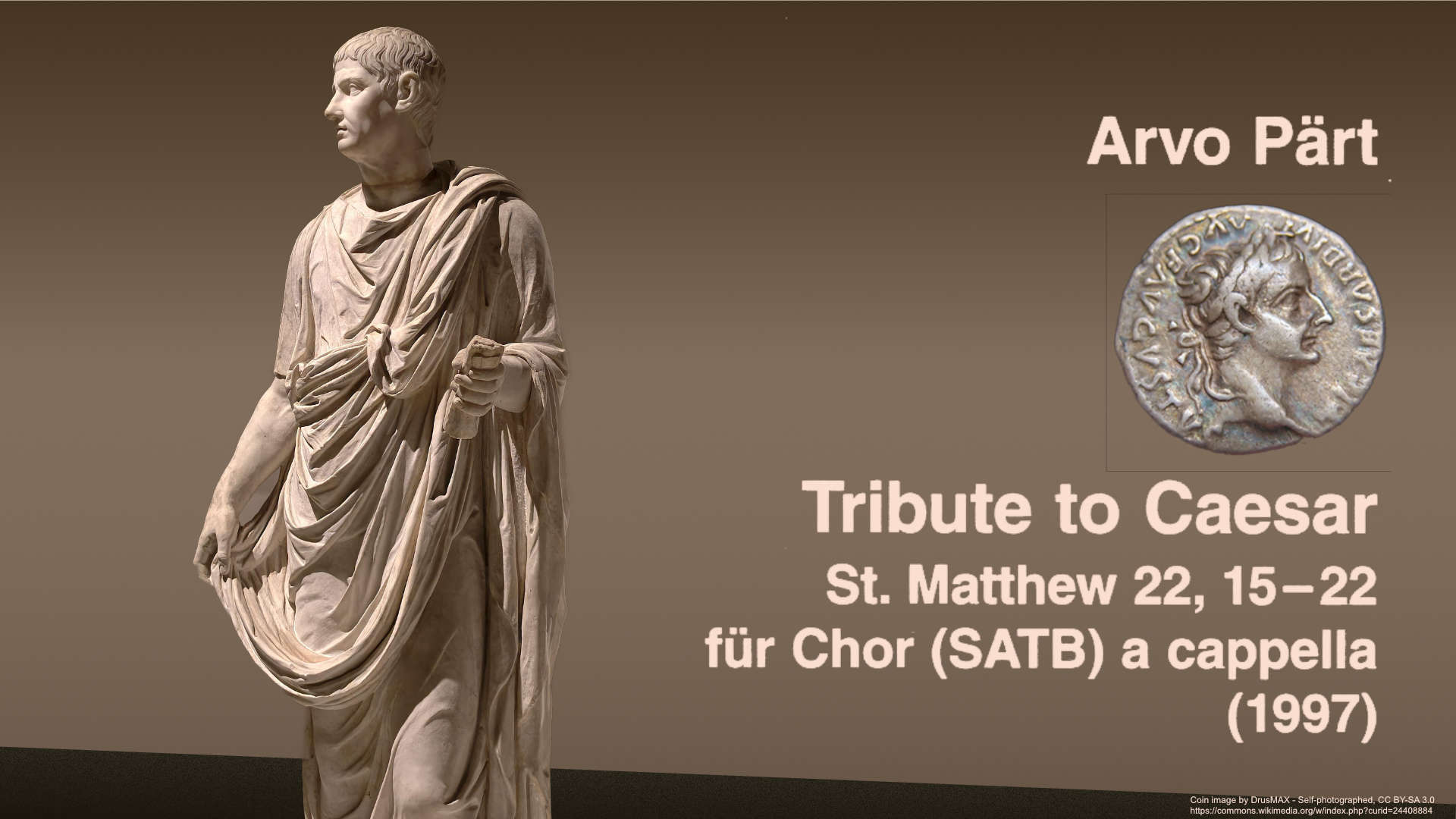
Tribute to Caesar was composed with another a cappella choir piece, The Woman with the Alabaster Box for the 350th anniversary of the Karlstad Episcopacy in Sweden. Both works were premiered by the Erik Westberg Vocal Ensemble in Karlstad Dome in October 1997.
Although separate works, they have some common features. Tribute to Caesar also presents a scene from the Gospel of Matthew, where the Pharisees question Jesus about the tribute. Jesus’ words have also been given here to the bass voices, the speech of the Pharisees is sung by all the voices together. Both pieces were composed for an English text. Because of the multitude of the monosyllabic words in English, according to the rules of the tintinnabuli method the melodic lines move very little. Therefore, Jesus’ words differentiate from the gradual motion of the others using a more dynamic vocal part with larger intervals.
- O Nata Lux
-
Date Posted: Mon, 5 Jan 2026
_image_1A.jpg "O Nata Lux")
Lucy Walker's setting of O Nata Lux de Lumine (O Light born of Light) was commissioned by the Choir of Pembroke College, Cambridge, to commemorate the occasion of Candlemas.
Audiences often comment on how much they like this piece and it has also become a firm favourite of many of our choir members.
Echoing the C10th text, the motet is rich in light imagery. The recurring motif, first heard at the opening of the piece, unfolds from a single pitch into glowing harmonic colours. After a luminous climax where the texture reaches its widest span, with a soaring soprano solo, the piece ends by returning cyclically to the meditative state of the opening, fading to a single note once more.
- Bring us, O Lord God
-
Date Posted: Mon, 5 Jan 2026
Harris's Bring us, O Lord God and its sister work Faire is the Heaven are two of the most rewarding anthems for double choir in the Anglican canon. This piece was composed in 1959, not long before Harris's retirement from a distinguished career as a teacher and director of music. The textural mastery that Harris achieves in the work are testament to his tireless efforts at the musical helm of institutions such as New College and Christ Church Cathedral, Oxford, and St George's Chapel, Windsor. It is widely regarded as a profound, "stunning" choral achievement. The text is from a sermon by John Donne, a priest and poet:
Bring us, O Lord God, at our last awakening, into the house and gate of heaven, to enter into that gate and dwell in that house, where there shall be no darkness nor dazzling, but one equal light; no noise nor silence, but one equal music; no fears nor hopes, but one equal possession; no ends nor beginnings, but one equal eternity; in the habitations of thy glory and dominion world without end. Amen.
Donne’s words are about death and are often read as a prayer at funerals. But it is far from morbid. Donne flips death, often euphemistically referred to as “falling asleep”, and calls it “our last awakening”. We awake to God in heaven to find that we are no longer pulled by the binary opposites of darkness and dazzling, noise and silence, fears and hopes, ends and beginnings. Instead, we will find all things in balance, with composure, harmony and constancy. We will be at peace, free of struggle.
It has been said that Donne gives us a glimpse of heaven through his sublime words, and that Harris reveals even more of its wonder in his setting for double choir: the synergistic combination of words and music shimmers in holy serenity. We are drawn into the prayer’s ‘one equal music’.
Bring us, O Lord God was composed for unaccompanied double choir, featuring lush, intertwining harmonic lines. This use of eight-part vocal counterpoint creates a sound perfectly suited for cathedral acoustics. The piece is now a cornerstone of the choral repertoire. Reviewers often comment on the anthem's thick-texture and ardently emotional style that Harris uses to deliver a radiant picture of heaven. The anthem builds to a grand, resplendent climax before transitioning into a mystical and magical set of concluding 'Amens'.
- Upon Your Heart
-
Date Posted: Mon, 27 Oct 2025
This is an a cappella setting of text from Song of Solomon by Canadian Composer Eleanor Daley, who is a Canadian choir director and composer with a growing global reputation.
The text in this setting is more often referred to as ‘Set me as a seal’ from the first line of the text.:
"Set me as a seal upon your heart, As a seal upon your arm, For love is strong as death
Many waters cannot quench love, Neither can the floods drown it;
Set me as a seal upon your heart, "etc..
Daley’s setting is in no way reminiscent of other settings, yet is as expressive as the more widely-known versions by composers such as Walton and René Clausen.
The choral texture is interspersed with several semi-chorus passages which Daley uses to vary the shape of the piece alternating between the upper and lower voices.
- Richte Mich, Gott
-
Date Posted: Sun, 19 Oct 2025
Richte mich Gott is one of three German-language psalms Mendelssohn wrote in 1843. After all three were performed he then then revised them in 1844-1845 and they were published as a set in 1849, shortly after Mendelssohn's death.
Richte mich Gott is an 8-voice setting of Psalm 43. Many 8-voice motets are written for double chorus (2 groups of SATB), but this motet is for a single 8-voice ensemble (SSAATTBB), clearly deviating from the common approach of separating the music into two equal SATB choirs, Mendelssohn chose to separate the ensemble by 'voice' parts, often writing for the men’s voices alone or the women’s voices alone.
The piece opens with contrasting alternate sections from the lower and upper voices, coming together for the grand "Send your light and your truth." before separating again before finale of the motet.
- Fyer, Fyer
-
Date Posted: Mon, 15 Sep 2025

"Fyer, fyer" was published in The First Booke of Balletts to Five Voyces, 1595.
It is a widely recognized and popular 5-voice madrigal by Elizabethan composer Thomas Morley. It is noted for its engaging, fast-paced nature and 'cheeky' lyrical content.Fyer, fyer! my heart! [Fa la la.]
O help! Alas! Ay me! I sit and cry me
And call for help, alas, but none comes nigh me!
The madrigal features quick-paced, fragmented phrases for the "fire" cries and slower, mock-tragic sustained notes for the "ay me" sections, showcasing brilliant word painting. It is frequently praised for its ability to convey the frantic, excited nature of new love through both vocal lines and music.
"Fyer, fyer!" remains a popular repertoire choice, being performed by choirs of all sizes across the world; it is often featured in collections of English part-songs
- Hymne à la Vierge
-
Date Posted: Sun, 6 Jul 2025
Pierre Villette's Hymne à la Vierge for unaccompanied Mixed Choir was completed in 1954, based on a poem by Roland Bouheret.
Pierre Villette was a contemporary of Pierre Boulez at the Conservatoire National Superieure de Musique in Paris. Villette was prolific in many fields of composition - vocal, orchestral and instrumental. Brought up in the choir school tradition - he was a chorister at Rouen Cathedral - his extensive output of church music consists mainly of motets and small-scale works for chamber ensembles and choirs. Drawing on early music, especially the Gregorian chant that he had sung as a child, he combined it with the exotic textures and harmonies inherited from Messiaen and Poulenc.
The Hymne à la Vierge is Villette’s best-known work - an a cappella setting that is melodious, homophonic and chromatic, with some delicious harmonies in the four-bar coda showing the influence of the modern harmonies prevalent in the Paris of the 1940s and 1950s.
- Ave Maria (Elberdin)
-
Date Posted: Sat, 19 Apr 2025
There are many settings of Ave Maria that have been written over the centuries. The text will be familiar to many across the world, especially those brought up as Catholics, who will know it as the words of "Hail Mary...."
Particularly well known is the setting written by Charles Gounod to sit above a Bach prelude and then became a stand-alone song. Also, Schubert's version is widely known and performed frequently. However, for choirs like Reading Phoenix, the unaccompanied setting in F Major by Anton Bruckner, written in 1861, is considered one of the best - it is setting that the choir still sings today.
It was a real pleasure then to discover an excellent new setting "Ave Maria, Gratia Plena" written by the young Spanish composer, Josu Elberdin Badiola (b. 1976), in 2019 and used as a set piece for the 53rd Tolosa Choral Contest in 2022.
The piece has a delicate opening section that gradually builds to broad, dense melodies underpinned with strong supportive harmonies with a calm Amen section at the end. This Elberdin work is a piece that the choir enjoys singing and we issued a recording of it in 2024.